


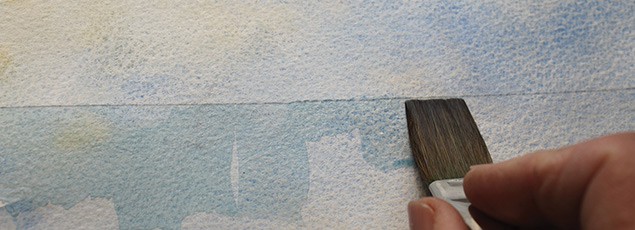
Straight edge brushes were traditionally used by the sign writer and calligrapher. Now however, for the painter to leave this valuable tool out of his equipment is a great mistake.
Every painting is a mixture of the defined or the undefined, or as I tend to refer to them ‘mush’ and ‘anchor’. The straight edged brush is the perfect tool for painting in the anchors with freshness and simplicity, yet with accuracy.
(Click an image to open gallery and read tips.)
-
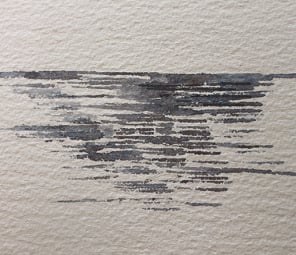
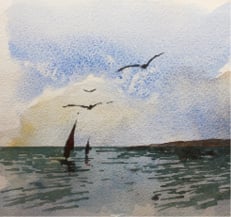
- Fig. 1. Using a ¾ inch you can create the effect of light on water effectively by simply allowing the tip of the brush to make its mark, almost like block printing.
-
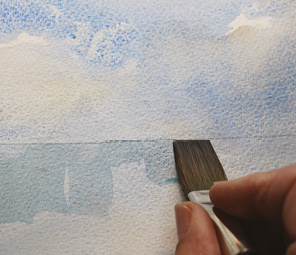
- Fig. 2, 3 & 4. Apply this over a wet in wet sky [mush] as a horizon and reflection [anchor] and you have the basic structure of your painting.
-
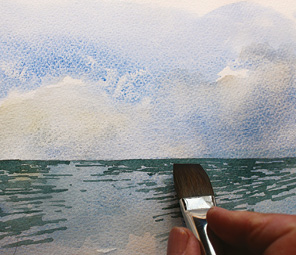
- Fig 3.
-
- Fig 4.
-
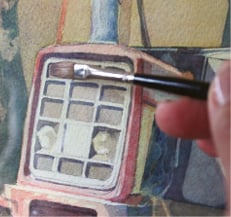
- Fig. 5. The straight edge comes in to its own when painting repetitive shapes. Take a look at the radiator of this old tractor. Each of the half tone areas is painted with one stroke of ¼ inch one stroke brush and the dark shading on two sides of each aperture is a mark made by a ¼ inch bright. The detail is precise but not overdrawn.
-
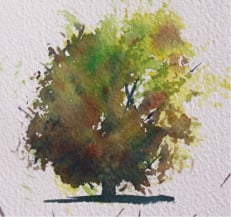
- Fig. 6. As far as painting trees is concerned the straight edge has enormous versatility. By using wet in wet method with the bright there is a bit more colour differentiation than with the a round brush and then the marks on the bits of dry paper show the linking branches freshly and without labour.
-
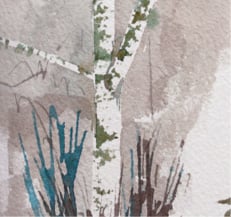
- Fig. 7. The silver birch is defined by the half tone background with the detail at the base of the tree provided by a ½ inch one stoke on its side being dragged downwards.
-
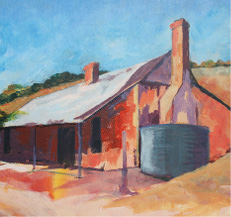
- Fig 8.
-
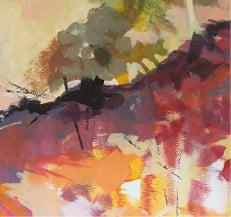
- Fig 9.
When using acrylics straight lines are always something of a challenge because controlling the weight of the line is difficult with a pointed brush however steady you are of hand! In buildings this can mean that they may look either overworked or ragged. Straight edge brushes solve the problem. Look at the posts on the little Outback house (Fig. 8) by ‘printing’ them by vertical marks one after the other the posts look straight and tonally correct. Also in acrylics angular marks superimposed over one another give a lovely loose structure to vegetation (Fig. 9) especially with subtle variation of tone a colour.
So, whether my painting is wet in wet or wet on dry, of natural or man-made structures, or of landscape or close up detail for me the straight edge brush is a resource I cannot be without.
